1st. day. A camp. 10a.m. July 20th.
Got up soon after 6p.m. and after breakfast started loading up the sledge. When we were nearly finished, Archie, and Robert, with a damaged ankle, arrived: this was great relief to us, as it meant they would look after the Dupelik team. In the morning I had taken our sledge and half our load on the rigid to the bottom of the glacier and now we took the other half with a certain amount of difficulty, but Archie came to help and we all pushed to the bottom of the glacier. There we put everything on the Nansen (John is really an expert at lashing up a sledge) and towing the empty rigid, we started off at 11p.m.
It was hard work going up the glacier, but we reached the dump-flag eventually and from then on it was only slightly up hill; but though the surface was quite good, we could get no pace out of the dogs. We went uneventfully along the line of flags, all the time getting a fine view to the West and over to Spitzbergen. At the flag where the direction of the line changes we were rather stumped, as we didn't know how far we were from A or whether we had hit one of the V flags. We could only see one flag ahead, and it was always a bit misty on the higher side of our course. However, it cleared and then we could see a line of flags, and then all the way to A. We passed B without stopping and went on for a few hours until the clock said 9.30 but the sun 12. Very tired: out of training, and I'm not used to the short ski I've been wearing. We pitched camp quite quickly for the first time, and tied the dogs to ski stuck well into the snow.
2nd. Day. Wahlenberg Glacier Camp. 1.30p.m. July 21st.
Up after a fine sleep of about 7 hours in the tent which seems a success. It is adequately wide and there is lots of room below our feet, and at each side of the "sideboard" we have more or less a private locker. Our clock broke almost at once, and a few minutes later I didn't see the thermometer that John had stuck on the rigid, and knocked it off and it broke. It was misty when we went off and we saw that it was thick in the bay, which was a nuisance as we had to find our way down. We went down and down and soon found streams on the glacier: these we had to cross and they gave some trouble, as ski are such a nuisance then, but almost indespensible otherwise. A little earlier we saw a bear-track coming up the glacier - he's stayed too late in the south so he has got to cross the ice-cap to get north. It cleared, and we saw the way down the glacier. We made for the moraine at the side, and then stopped and went ahead on foot to look for the dump: this we found in the middle of an enormous river. John waded to it on stepping-stones, while I went back for the dogs to get the sledge down on the other side of the river, from which it was easier to reach the dump. All went well for a bit until I came to a stream in a deep and wide gorge, which I clearly could not manage by myself. So we decided to leave the dogs and take the sledge down ourselves. By going up and down each stream until we found a good crossing place, we got across them all and then down to the dump. It was all absolutely soaking, of course, and the chocolate, which was in tins which were supposed to be hermetically sealed, was rotten. We were furious with Cadburys. We threw away one tin and kept the rest hoping it would be better.
We got back up the glacier a bit before crossing any streams. First we tried throwing the boxes over, but John missed the opposite bank with a dog pemmican tin, and it went floating down the stream till John did a magnificent rugger tackle at it in the water. After that we bridged the streams with the sledge, and while John held it steady I handed the boxes over. We found the biggest stream bridged at one place, which was fortunate and the sledge got over all right though I fell through, but not seriously. We reached the dogs, and then by going up the glacier parallel to the streams we got up to where we had left the rigid with half the load. It was getting late, and we were very tired and the dogs couldn't manage the whole load, so we dumped about half the load, and taking things that were necessary we struck for the moraine on the East side of the glacier and reached it after a little more trouble with streams. We camped on land this time: it's drier and nicer except when windy. After supper we went to bed - still very hungry.
We must be a fine pair with our skis: neither of us can control them: my short ski are hopeless in streams, and I gave them up after a bit and wore gumboots instead.
3rd. Day. Wahlenberg Bay camp. After mid-day. 22nd. July
We did not sleep for long, and went off almost at once to fetch the rigid and the rest of the load. No new adventures. I found the aneroid broken in my windproof pocket - John had put it there without my knowing, so I probably crashed it on the ground! We then took the whole load down a tongue of snow for nearly a mile. Then we took part of it on the rigid down a narrow snow gulley and then over stones, but it ran terrible badly, and when we got to the beach the runners dug in, and even with quite a small load the six dogs and two men could hardly move it. So we left it and the dogs, and taking on our backs two 50lb pemmican tins and the theodolite, we went ahead to reconnoitre.
We went along the shore of the bay for a bit and crossed quite a big river without much difficulty where it was wide near its mouth. We then went out towards Carfax (?) hill, but kept to the left of it. It's wonderfully fertile here and we saw many birds, including a turnstone, and reindeer, and the ground was quite yellow with the Arctic poppy. At last, after a walk of about 7 miles, we reached another river near the end of the valley, beyond which there was sort of shelf ice, and we dumped our load - very tired - and returned. We took the dogs off the rigid, and went back and camped at the bottom of the snow tongue where we had left the sledge etc.
It's been wet and cloudy, but it is better to get this weather over now and then it may be fine when the survey starts. We don't get enough to eat with all this manual work!
4th. Day Lagoon camp. About 7p.m. 23rd July.
It rained a lot during the night, but the tent proved quite watertight. After breakfast we portaged the rest of our stuff down to the rigid, and then took down the Nansen with nothing but skis on it. It ran very well on the beach and John decided to risk taking loads of nearly 200lbs on it. So we proceeded thus till we met the first stream, and then returned for the rest, leaving the rigid and a note on it saying that all was well but that we found the rigid hopeless and were proceeding with the Nansen. After this first stream we had a fine run of nearly two miles, even if the rate was a bit slow. I went ahead to pick a route while John drove, then back again to fetch the rest of the load. Relaying is certainly a nuisance, but better than carrying everything!
We were very lucky in finding the big river bridged by snow high up. We made about 4 miles altogether, relaying in this way, before we found the runners wearing too much, and John decided we must portage the rest and take the sledge along empty. So we carried loads of about 70lbs in three loads, but we gave up before reaching the dump we dropped yesterday: we had been on the move about 20 hours and, tired out, decided to camp. Our last three days have been 27 hours long, and not more than 7 in bed. The portaging is very backbreaking, and the carriers dig into your back. It's funny how one occupies the mind during the day. I spent a lot of the time trying to think of all the New College dons! We are both very hungry: John shot at a duck but missed it; we refreshed ourselves at one time by digging sugar lumps into the margarine and eating both.
5th. Day Ivory Gull camp. 7.30p.m. July 24th.
There was more rain during the night, but the sun was up to tell us the time when we got up. After breakfast (how inadequate is 4oz porridge and 1 biscuit for this sort of existence) we carried our loads to the next river, and lastly brought along the sledge. The river was wide but very easy to cross. We saw about 35 geese slowly making their way across the lagoon. Beyond the river the ground was covered with hard snow, rather like shelf ice, cut up by many stream beds. The dogs could easily manage the whole load now, and we managed the streams without trouble though the runners bent badly, till when we were crossing quite a small one there was a loud snap and one of the runners was broken. This usually means the end of all things, but John devised a repair by cutting some of the ash off the handlebars and binding it on top of the broken runner, screwing the broken parts together and covering the binding with tin sunk into the runner in front to avoid catching. While John went ahead to find a way up on to the ice-cap, I started on the runner, and when he came back, having found a way up, we finished it together and also strengthened the other one in the same way. Then we went off again.
There was a very tricky stream to cross at the end, but I put crampons on my gumboots and this proved a very good combination. After that we had to carry everything up a steep moraine to the edge of the ice-cap about 150 ft above the stream. Just on the land at the edge of the ice at the top here we made a really nice camp: a glorious evening with charming view, and even the ugly Wahlenberg Bay looking quite pretty. Remembered another New College don! Feeling encouraged tonight: we have been slow, but we have reached the East Ice and finished crossing the Rijps valley.
6th. Day. First East Ice camp. 25th. July
It was beginning to get murky when we started off. Above us were rocks where many Ivory gulls were nesting, but none of them came near enough to us for us to add them to our larder. It was real hard work for us all at the beginning, getting the whole load over a lot of melting hummocks, John sweating hard and pulling in front and driving the dogs as well. At last we got over the hummocks and on to a hard honeycombed surface, good for the sledge and not bad for the dogs, though their feet bled a little. It was up hill all the time, and then we ran into a few smaller morasses which took us a long time to get out of. You are so helpless in them: if you wear ski you are almost immovable, for it is like walking in treacle and you can hardly move your feet: if you take your ski off - and in my case that takes a few minutes - you sink down probably well above the knee. The dogs just hate it too, and as soon as they reach the better stuff beyond they just sit down with the sledge still in the morass.
On and up without much more trouble from morasses until we got into a really big one and could find no way out. If only we had a decent sledge with turn-ups at each end all would be better, for then you can always put the dogs on at the other end and get out the same way as you got in. But to turn in anything but a very large circle is impossible. We sweated and pulled for ages, and in the end had to take half the load off the sledge, and by taking a very wide circle we got it down to some moraine running up from the Rijps valley, and then fetched the rest of the load. We had not expected these morasses on the East Ice and had left the toboggan bottom in the valley, and it would really have been a help now. Afterwards we had better luck, and on getting higher, we got on to drier stuff and at last pitched camp. It was clear by now and we got a good view back towards Wahlenberg Bay and to the north of Rijps valley. Still very hungry.
7th.Day Mid-East Ice camp. 2p.m. 26th. July?
It was fine and clear when we pushed off on quite a good surface. After a bit John noticed that he had dropped his gloves, and skied back to fetch them while I went on with the sledge. After a bit I ran into a morass which I could not see. It was no use going on and it took me at least three quarters of an hour getting it out again. Two men are really necessary for a sledge at this season. Got out just before John caught up after finding his gloves. After that all went well, the surface being quite good, and we got a grand view to the N and W, steering a course of 60º across the ice-cap.
I soon began to find that this ice-cap sledging is not so much fun, for though all goes well we could get no pace out of the dogs, and though the view is fine it changes so terribly slowly that you soon get bored. For about eight hours it must be bad enough, but we are doing about 12 hours a day now, and it is terribly monotonous. Remembered another New College don!
After a bit we took to reading in turns and I read the cricket part of the "Lonsdale Anthology of sporting verse and prose." Really I got quite absorbed in the players and the green fields, and then looked up to see nothing in front but six dogs and snow for miles and miles. We are now on to a tin of lump sugar, and have 27 lumps per day. I keep them all for sledging, and eat none in the first two hours after breakfast, then one each twenty minutes for the next nine hours, and then none in the last hour when the thought of the approaching pemmican hoosh (?) is enough to keep you going. The lumps help you to estimate the time if the sun is invisible. All decent chocolate finished now and we are on to the filthy wet stuff. How we curse Cadburys!
Eventually we camped high up on the ice-cap. We often make scones for supper now, and how glorious they are. We are about half way over the ice-cap and have just seen an ivory gull. Also a bear-track - apparently en route from Cape Leigh Smith to Rijps Bay.
John's opinion of the tent is going down: we pitched it rather badly today with the door too near the head, and also now the tin on the runners collects snow during the day, and in the tent drips continuously after our lighting the primus.
8th. day. Morass Camp. 3p.m. 27th. July?
Again a fine morning and the sun shining in the north when we started, but all the land was covered in a low mist. So we continued on our compass- course and avoided a few morasses and saw another bear-track. John skied ahead and navigated, while I drove the dogs. Then we began to get down into the mists - and morasses. Now we were really in for trouble, for the mists obscured everything. The dogs were soon absolutely demoralised, and we had to treat them with the whip handle to get them to move at all - and it broke. Old Ayo is rather done, and Pamiok absolutely knocked up. Whichever way we went the morasses got worse and worse. We found a bear-track and thought he would have chosen a good way up, but we soon had to give up following it, as it went too far off the course. I think John was over-enthusiastic today: it would really have been more sensible to camp and wait for clearer weather - as it was, we floundered literally for hours making practically no distance.
We dumped half our load and went ahead - there is no danger in doing this as we are leaving enormous tracks - but we only found more and more morasses and one or two streams. If only we could have persuaded the dogs to go down the bed of a wide shallow stream all would have been easy, but they hate the water and we couldn't manage them. In the end we had to turn back as we could not camp anywhere there, and returned to a drier patch near where we had dumped. It was not easy to tie up the dogs tonight, and in the end we had to tie them to two pemmican tins: one of them had had its soldered tag slightly torn so that there was a slight hole, and before long old Ayo had got it open. He is a wonderfully clever old beast. John noticed before they had opened it much. A wet camp, and we are soaking too - and ravenous.
9th Day. Van Otter (?) camp. 28th July
It's the ups and downs that make life so worthwhile. John woke after a few hours and saw the mist had cleared, but was too tired to get up and proceed, and went to sleep again, having unpleasant dreams owing to a troubled conscience. But it's as well he didn't, for when we were up at 10p.m. it was most glorious; the mist had cleared away, the sun was shining in a cloudless sky, the ice-cap was glittering as if it had diamonds scattered over it, the black land was quite close though we couldn't see much owing to the convex shape of the ice-cap, and out to sea we could see the islands of Foyn and Broch (?) and Charles Xll - and to be practical there was a beautiful frozen crust on the snow.
John went off on ski to find the way down while I got things out to dry in the sun, and made a new whip-handle, and did a few other jobs. John was not long and came back to say that our goal, Van Otter's Island, was below us, and the morasses were frozen hard on top; so after relaying just for the first quarter of a mile we took the whole load through the morasses without any trouble. We had a little trouble with the streams at the bottom, and Pamiok cut his foot badly in one, and we had to put a boot on it.
When we reached the moraine at the bottom we pitched camp - we have taken 8½ days to reach here, a bit more than we had hoped, but our difficulties have been great, and I think some people thought we would never make it at all. John theodolited, while I pitched the camp and substituted the tin from a dog-pemmican tin that we have just opened for the chocolate tin on the broken runner. We then had a lunch and set out to theodolite.
What a joy to walk on ones' feet and on land! At a big river we nearly had a serious accident. We have broken or lost most things, but as long as the theodolite and angle-book remain intact the journey will not be in vain. We crossed the river about 100 yds above the sea. I could cross it easily in my gumboots but could not get up the other side, so took off the carrier to hand to John who had already climbed up the snow bank. As I did so, the theodolite slipped out sideways into the fast stream and was hurtled towards the sea a hundred yards away. It was a terrible moment, but I dived at it as it floated away, and threw it on the bank. The water had hardly got into the case, and the bump on landing seems to have done no harm.
It was sunny and fine and there were lots of ducks at the water's edge, but it was an off-shore wind and we would not have been able to recover any we shot. We saw two reindeer very close on a snow patch before they ran away. By the time we had reached the top of the hill a mist had settled on it - John's usual luck - and we discovered we had climbed the wrong peak; so we trudged home, apparently tired as we both fell asleep when we sat down for a rest. A feast at night, including a tin of sausages to celebrate our arrival at van Otter's Island.
10th day. Earthquake camp. 2a.m. 30th. July
We had a good sleep and got up about mid-day. John built a cairn, and while he was doing so he thought he saw the site of the dump to the east of us, while yesterday he said he thought it was to the west. So he went down and brought some of it back, while I broke up camp and packed up and wasted time. When he came back we unlashed everything, and I went off with the dogs and empty sledge to fetch the rest. Had difficulty with one stream, but no more. On the way back the dogs got mad, and I could not stop them following their old tracks, so they crossed the bad stream at the same bad place. The sledge fell in and I hung on while they pulled it vertically up the bank, and I was dragged along for quite a time before another stream made them hesitate, and I got on to the sledge and safely back to camp. Unfortunately I lost a crampon: it was tied on by its canvas bindings to the sledge, but these must have broken, and since it is quite likely that it was in a stream that it fell off we did not think it worth while to go back and look for it.
Then we started off for the next camp, and reached it without any serious trouble, on a moraine stretching far into the ice-ocap. The streams, of course, slow us up terribly, but they are rather fun, and each presents its own crossing problem. We are always so afraid of breaking our runners again. Today our method of crossing was thus: a bit more than half the load was lashed permanently on the sledge and the rest quickly lashed on top. At a stream we would take the top load off, throw it over the stream, then throw the dogs over, then John would jump over at a convenient place, and, with a rope on the forearm he would pull and I push and let the sledge down gently until it bridged the gorge. Then we would attach the dogs, and pull it up the opposite bank. The tail of the sledge always dips in, but with a lightened load the runners stood up to all the shocks. What will happen when we meet a stream that John cannot jump or the sledge will not bridge, we don't know.
Supper and bed after reaching camp, as we have had too long a day to do any theodoliting on top of it. Great jubilation, for there is lots of man-food, dog-food and paraffin in the dump - and also an undamaged tin of ovaltine chocolate.
11th day. Calamity Camp. July 31st.
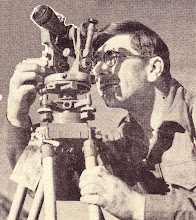
We visited Bear head this morning; it was fine and hot walking there. The usual procedure when we occupy a station is that while John's setting up the theodolite I take photographs all round. Then he takes a round of azimuth angles, which I write down and work out differences and means, to see that he makes no obvious mistake, then elevations; then he draws a panorama of the coast and ice edge and then takes depression angles to the coast and angles to conspicuous points of the ice edge. At intervals, to keep warm, we build a cairn. We saw two divers on a lake on the way home, but had no luck with the rifle. When we got back we had a lunch before moving on, and felt a big "firnstoss."
Soon after starting, we met a bigger stream than ever. John jumped across and we did not doubt but that we would manage it in the same way as the others. We threw the dogs and some of the top lashing over and let down the sledge very slowly. However, the gorge was nearly too narrow, and with sloping banks each side, and we slowly slipped down and all finished in the stream. It was a fast stream, about 18 inches deep with an absolutely smooth ice bottom, and we were swirled down at 8 or 10 miles an hour, hanging on to the back of the sledge and hoping to jam it at one of the many turns, but it was always much too smooth. After a bit John turns round and says "this will end in an ice-cavern" (they all go underground at the edge of the ice-cap.) Still we were whirled along helplessly, and after about a quarter of a mile John says "Get out" - he had nailed boots and managed to scramble out, but I could get no grip at all with my gumboots and was swept along for another 100 yards, where the stream split into two and strong eddies had made deep furrows in the bottom, and I managed to stop and get out.
John meantime had raced down the bank and caught the sledge at the moraine by a boulder. I had banged my knee badly and scraped all the skin off my left hand (and lost a mitten) in trying to get a grip on the bank. No serious damage to the sledge except that the handlebars were broken. We took everything up to where we had tried to cross the stream, and decided to camp and get warm and dry and carry out repairs, and then go on tomorrow. Unfortunately there were still some things on the other side of the river, and John jumped over to throw them over, but when he tried to throw a dog-pemmican tin it was too heavy and fell short, and it was whirled down the stream. We ran down the banks for a bit, but never saw it again. For the next boxes I threw a rope over, and John lashed it round the box and threw it, while I held the rope for safety, and they all came across without loss. And so we camped, very wet, but our losses have been surprisingly small - one dog-pemmican tin (8 days), one mitten, one pair outer gloves and two pairs inners, some lumps of sugar and some margarine.
12th day. Question Mark Moraine Camp. August 1st.
Up about 12. After breakfast, I went ahead to reconnoitre while John mended the handlebars. It was rather morassy, but not bad, and then I came to a stream I did not try to cross alone - on an expedition it is foolish to take unnecessary risks, and it's not fair on the others - but it seemed to be the only one, and this one did not look as if it would give much trouble. So I returned to camp, and with a view to lightening our load and making it more convenient we went through all our things and threw away the clock, three komagers, our 1 gallon tin of paraffin (now half full) and some other articles, and thus managed to do with one (?), and this with the loss of the pemmican tin made a lot of difference. Then we started off.
The morassy stuff gave us no trouble and when we reached the stream we tried a new method of crossing it. We threw the dogs over - we did not disentangle their traces this time, and did not throw at a good place, and they were all washed down the stream for about 50 yards, until one got a grip on the bank and they all walked out, shook themselves and rolled up in a ball. We then unlashed all the load, and John jumped over with a rope and we let the empty sledge over slowly and jammed its bow into the bank, and John stood on the bow to keep it steady while I passed things over, using the sledge as a bridge. It's a good thing too to tie the dogs on to the sledge, for they get such a wonderful grip and if the bridge slips and the sledge goes in, we do not lose it. Our policy now is safety rather than speed.
Unfortunately I lost the other crampon in the stream today - I had not tied it on adequately and it was washed off my foot. As long as we are among streams we do not lash up the sledge, as it all sits on so well, and thus we waste little time at each stream. The next stream was wide and splitting and by choosing our route we crossed a lot of smaller bits without taking off the load, and went through the last part where it was 15 ft. wide, and correspondingly shallow and slow. As we were approaching the moraine we saw something on the snow just ahead, greatly excited, as we naturally hoped it would be an 'Italia" relic, but it turned out to be Andrew's balaclava and a candle end left in a camp on the Leigh Smith journey in November. A good camp in the moraine: John theodolited while I put up camp.
13th day. Question Mark Moraine Camp. 5a.m. August 2nd.
It was a murky morning, and we were not sorry: slept on and mended windproofs etc and read a bit. Then the weather improved and we went off to Canine Point, where it was cold and windy and we were glad of a sheltered ridge from which some of the work could be done. On the way we found that both the next streams are bridged a little lower below the level of the camp, and there appeared to be no more streams further on. Many birds on the cliffs of Canine Pt. We have lost nothing today, nor have we got wet!
14th day. Half-way camp. 2a.m. August 3rd.
A bank holiday in England, I suppose, but not for us. Moved on to our next camp, over the glacier, and this was easy as the crevasses were obvious and must have drained all the water, as we met no streams to speak of. Then after pitching camp we went to theodolite on Glacier Point, and did the usual. We saw a fine spout of water in the moraine, where one of the ice-cap streams that go underground when they meet the moraine, spouts out again. On the way home we had some difficulty in finding camp again, for we had not observed our position carefully, and returned by a different route. A big supper at night with many scones.
15th. day. Half-way camp. 4a.m. 4th. August
It was sunny and very windy at breakfast, so we did not start out immediately afterwards, but John improved his "Emir" balaclava which he made the other day out of a vest to replace his lost balaclava, while I, I'm afraid, slept - my hand is always painful in the morning now, and it keeps me a lot from sleeping, as I can't get into a comfortable position. Poor John, he had to do a lot of things nowadays that I cannot manage with one hand and teeth etc.
Then we set off for Flat Pt. (or Cape Brunn), promising to be our largest walk up to now. In the sun it was very hot walking. I have only two things to complain about John, one is his pace of walking, which compels me to run at intervals if I am to keep up; and the other is that he likes very thick pemmican hooshes, while I like them thin. When we got to the flatter beach John shot a duck which we thought we could recover, but we couldn't and it went slowly out to sea. We must have passed near a skua's nest as two of them flew round and round and pretended to have broken wings to divert our attention. We (mostly John) shot 14 shots at them, but killed neither.
At last we reached the top of Flat Pt. where we found a cairn partly tumbled down and a stone with the initials B.M.T. and O.N.T. scratched on it. We think it must have been put up by Nordenskjiold's men. Afterwards we ascended the Camel's Hump to theodolite again and on the way John killed the skua first shot. We returned to camp after a long day (during which I lost my balaclava), and we were glad to have the skua to help to satisfy our big appetite.
16th. day. King Edward Vlll Glacier or Tin camp. 1.30a.m. 5th. August.
We had a good sleep of nearly 10 hours: it was hot in the tent with the sun shining on it, but below and around it was misty, so we could not move as we had to cross the glacier. Did various jobs - we both made mittens and gloves out of old stockings - and I cleaned my hand. It got cleaner slowly, and at 6p.m. we decided to lunch and then get away. We are getting on so well that we hope to be home a few days earlier than expected, and are eating three days food. John still very hungry.
With the clear sky the ice-cap surface was frozen hard, and though very rough it was a good surface. John went ahead on ski while I managed the sledge - a good arrangement, and we went better than we have for a long time, the dogs showing some signs of life. We had one bit where there were smallish crevasses; rather fun as you knock pieces of ice down, and as they fall you can hear them hit the side emitting a higher and higher note the further they fall. Merratark fell down one that was nearly full of water, but got out quite easily. Pamiok has been pulling better today.
Suddenly we found the streams flowing in the opposite direction, and on our left was a hollow in the ice-cap - the ice must be very thin here. As we neared the edge of the glacier we came into a region of melt hummocks, and we left the sledge and prospected ahead. We saw that we could get off the glacier on to the moraine without any difficulty and since it was no use taking the sledge over the hummocks we pitched camp on top of a bit flat hummock. The bay is still full of mist, so we are going to bed hoping it will clear as the sun gets higher tomorrow. A few yards away a small stream flows into a crevasse with a deep gurgling note - as if we were in some power house.
Barter has started: John is always hungry, but I am getting enough now and don't think much of the wet Cadbury chocolate, so am bartering 1 slab of it, 8oz, per half a slab of ovaltine chocolate (ie 2½oz) - he gains enormously in quantity, I in quality.